Magic, by default, is disabled on Aedra by a planet wide anti-magic field that emanates from an elven artifact hidden in the mountains of Zoa along the westernmost part of the continent. It disrupts spells, disable magical items, and beings of magic will slowly wither and die while within it.
This anti-magic field is not absolute. Soon after the artifact was activated, strange minerals called wishtones emerged from the planet’s surface with the power to disrupt this field. On the far eastern isle of Immeria so many of these stones arose, and of such great power, they pushed back the anti-magic field thousands of miles, creating what is today known as the Zones of Magic.
The Zones of Magic
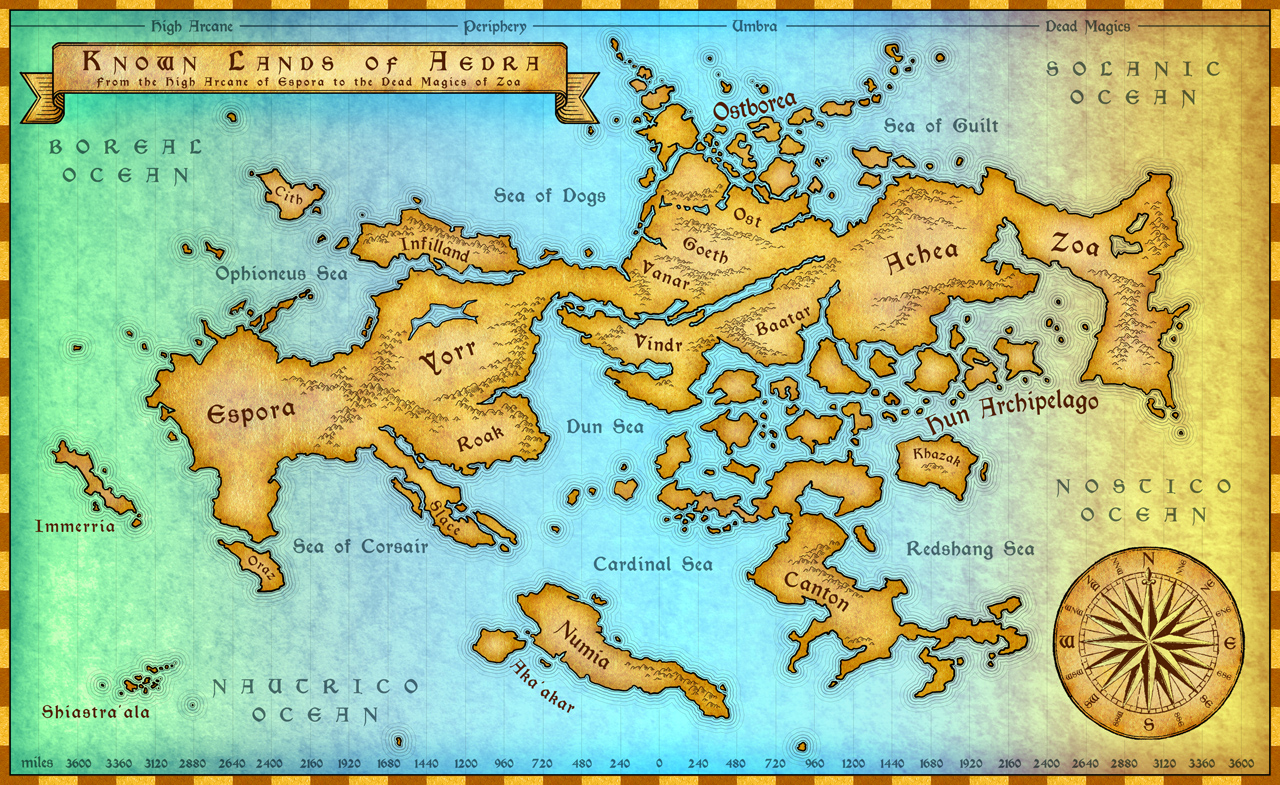
There are four defined zones of magic, though their exact boundaries are erratic and mutable. They are: The High Arcane, The Periphery, The Umbra, and The Dead Magics.
The High Arcane
There are no limits to magic within the High Arcane zone. It is a realm of infinite possibilities. This has it advantages and disadvantages. This zone covers the lands of Immeria, Shiastra’ala, Espora, Oraz, and Cith.
Mankind in this region wields powerful magics. Disease and famine is virtually unknown and the ravages of age are but a faint memory. Massive construction projects are possible allowing for fantastic cities. There is little need or want as most mundane goods are easily obtainable. Automated constructs perform most manual labor allowing citizens to spend their time on leisure and education.
But there are dangerous drawbacks to living within the High Arcane. The region is filled with magical beings, many of which are openly hostile to other races. Unreal are the least fettered here and can reach titanic proportions, leaving a wake of death and destruction in their path. Denizens of this region have to be constantly on guard to their rapidly changing environment.
9th level spells are castable on Immeria, while Espora is limited to 8th level spells or lower.
The Periphery
The High Wizards of Immeria named this zone The Periphery as they considered it the edge of where high magic is still possible. The region is constantly in flux, expanding and shrinking in influence sometimes hundreds of miles every year. Normally, the lands within its boundaries are Infilland, Yorr, Roak, Slace, Aka’Akar, and parts of Numia.
The constant flux of the Periphery has bred a nomadic nature in the denizens of this region. Groups tend to migrate as the Periphery changes, causing numerous conflicts and wars.
The chaotic nature of this zone has an affect on lifeforms. Many creatures not known for magical abilities display such here. Sorcerers are quite common.
Warlocks tend to congregate in the Periphery as they can perform the powerful magics necessary to establish contact with their otherworldly patrons, yet remain distant enough from the High Mages of Immeria to conceal their actions.
The normal limit of spells castable in the Periphery is 6th level. This can change rapidly if the Periphery is currently in flux. The limit has been known to increase to 7th level spells near the outer boundaries and drop to as low as 4th level spells near the inner boundaries.
The Umbra
This is last zone where magic is sustainable without the assistance of wishstones. It covers the regions of Ostborea, Ost, Goeth, Vanar, Vindr, Baatar, Canton, The Hun Archipelago, and parts of Numia.
Unlike the Periphery magic zone, the Umbra is very constant in position and strength. This consistency has made the region the most heavily populated of Aedra. The Umbra can experience a flux in strength, but this normally happens slowly over centuries, allowing civilizations to comfortably adjust.
There are numerous schools of wizardry in this region. These schools are bolstered by powerful wishstones to allow for magics more powerful than normally possible in the Umbra.
Magical universities serve two main functions: to find those magically talented that would normally be missed in a low magic region, and to create a defense against the encroachments of antimages that control Achea to the east.
Wishstones are a valuable commodity in the Umbra, especially in regions close to the Dead Magics, such as Baator and Achea.
4th level spells are castable in the Western regions of the Umbra. This limit decreases to 1st level spells as one approaches the Dead Magics.
The Dead Magics
The Dead Magics and the land of Zoa are almost synonymous. This is where the elven artifact responsible for the anti-magic field resides, the Maan Sarka.
No magics are normally possible in this region. Creatures of magical origin will experience great pain while within it and slowly die if not withdrawn.
Unprotected creatures that remain in this region for extended periods of time will experience other deleterious effects not present in the other zones of magic. They will slowly lose higher brain functions, becoming more more animal in nature. Their body will experience a similar change, de-evolving into a more primitive state.
It is unknown if these effects are reversible.
It is a region of animal savagery, filled with creatures out of the past. Great thunderlizards roam the landscape as well as other megafauna.
Wishstones do not naturally occur in the Dead Magics. Those possessing them are protected from the ill effects of the zone, but only temporarily as the stones will slowly burn out.
Wishstones
It is theorized that wishstones are Aedra’s autonomic defense against the anti-magic field; that she generates the mineral to push back damaging effects of the Maan Sarka. There are no records of their existence prior to the artifacts existence, and afterwards, numerous accounts of the stones appearing where none were before.
 Wishstones look like earth opals of various colors and sheen. They come in many sizes and power, and each are keyed to a different type of elemental magic. A caster with the proper wishstones will be able to cast spells the anti-magic field would normally prevent.
Wishstones come in five ranks of power, measured in what level of spells they can enable: minor (1), lesser (3), common (5), greater (7), grand (9).
To cast a prohibited spell, the caster must have on hand a wishstone of every elemental type found in the spell, and one of those stones must have a power level equal to or greater than the level of the spell. The same conditions apply to those trying to use innate magical abilities that mimic spells.
Magical creatures often build their layers around wishstones as it brings them rest from the discomfort the anti-magic fields can inflict.
A wishstone can be broken to cast a spell of its associated elemental type of a level equal to or lesser than its power level. The user does not need to have any magical training or abilities to do so. It is from this capability the stones gained their name.
These are the following known types of wishstones, how they are identified, and what elemental magic types they hold influence over.
- Fire: red and black, warm to the touch; fire and heat magic
- Water: blue, fluid interior; water magic
- Air: pale cyan, hollow; air and force magic
- Earth: reddish brown, heavy; earth and metal magic
- Light: white, faintly glows in dark; illumination and illusion magic
- Cold: white and blue, cool to touch; cold magic
- Lightning: blue and yellow, magnetic; electricity magic
- Melody (or Thunder): greyish brown, slight ringing sound; sound magic
- Body: pale green, red veins; life and nature magic
- Spirit: dark grey, mirror like; death, undeath, and spiritual magic
- Mind: pale orange; charm and mental enhancement magic
- Time: shades of violet; time magic
- Luck: multi-chromatic, vibrant; curse, luck, chaos magic.
- Law: black and white; magic with conditions and rules
- Truth: clear, magnifying lens; magic involving truth or the nature of things
- Space: black with gold sparkles; spatial magic
Banestones
Antimages know a secret procedure to corrupt a wishstone, transforming it into a banestone. These objects behave in the opposite fashion of a wishstone: repressing the magic they once assisted.
They are fragile things, capable of protecting their owner from magical attacks a couple times before shattering.
Banestones maintain the same visual appearance as their wishstone counterparts, but are inlaid with metal contraptions. It is unknown if a banestone can be reverted back to its original state.
 Mirrorworld